Bac Vs Sterile Water Can I purchase bacteriostatic water?
\nCan I Purchase Bacteriostatic Water? A Cautious Consumer Review for Older Adults
\n\n\n\n
Navigating the landscape of self-administered wellness regimens can feel surprisingly complex as we move past our mid-50s. Many men in this demographic, under the guidance of longevity clinics or specialized physicians, find themselves managing personal care protocols that involve the reconstitution of lyophylized (freeze-dried) powders. Whether these are prescribed hormone replacements, therapeutic peptides, or other specialized compounds, a recurring practical question consistently arises in patient forums and wellness communities: Can I purchase bacteriostatic water safely, legally, and without exposing myself to unnecessary health risks?
\n\nThe sudden surge of interest in this specific item isn\'t accidental. With the democratization of telemedicine and the increasing prevalence of age-management therapies, more mature consumers are taking an active role in sourcing their own clinical accessories. However, because this fluid acts as a vehicle delivered directly into the body, understanding exactly what you are buying is paramount. This review aims to cut through the internet marketing noise, providing an objective, independent look at the logistics, safety protocols, and purchasing frameworks of this essential diluent.
\n\nIf you are asking yourself, "where can I buy bacteriostatic water safely online?" or trying to figure out if your local pharmacy keeps it in stock, this guide is written for you. We will analyze the product based on structural quality standards, real-world case observations, and clinical limitations—without exaggerating results or making medical promises.
\n\n\n\n
What Is Preserved Diluent Water and Who It Might Fit Best
\nBefore diving into availability, it is vital to define what the product actually is. Bacteriostatic water for injection is a sterile, non-pyrogenic preparation of water containing a specific percentage of benzyl alcohol (typically 0.9% or 9 mg/mL) added as an antimicrobial preservative. The word "bacteriostatic" literally means stopping the growth of bacteria. Unlike single-use solutions, this specific formulation allows a vial to be punctured multiple times over a defined period because the preservative prevents any introduced microorganisms from multiplying.
\n\nThis product fits best for individuals who meet a very specific set of criteria:
\n- \n
- Patients on Multi-Dose Regimens: If your physician has prescribed a therapy where a single vial of medication must be drawn from over the course of several days or weeks, a preserved diluent is typically recommended to maintain safety. \n
- Experienced Self-Administrators: Individuals who possess the manual dexterity and cognitive clarity to follow precise aseptic techniques. For men over 55, ensuring you have a steady hand and excellent lighting is a fundamental part of the process. \n
- Monitored Healthcare Consumers: Those who are operating under a legal, valid doctor\'s prescription and need to source matching medical supplies that their insurance or primary pharmacy might not bundle automatically. \n
Conversely, it is entirely unsuitable for single-dose applications where standard sterile water suffices, or for individuals who have a known sensitivity to benzyl alcohol. Furthermore, it should never be used in neonatal care or for specific epidural/intrathecal procedures due to toxicity risks associated with the preservative in those contexts.
\n\n\n\n
Practical Benefits and Where It Falls Short
\nThe primary practical benefit of a preserved sterile diluent is convenience and cost-efficiency. When managing an ongoing health protocol, using a single-use ampoule of standard sterile water means that any leftover fluid must be immediately discarded to prevent bacterial contamination. A preserved solution, however, allows a single vial to remain viable for up to 28 days after the initial puncture, provided it is stored correctly. This significantly reduces the volume of medical waste and simplifies the daily or weekly routine.
\n\nHowever, the product falls short in several distinct areas. The presence of benzyl alcohol changes the pH of the solution slightly, making it slightly more acidic than normal saline or pure sterile water. For some users, this can cause a transient localized stinging or burning sensation upon administration. Additionally, it demands meticulous record-keeping; missing the 28-day expiration window can turn a helpful clinical tool into a safety hazard.
\n\n\n A Case of Successful Integration (Patient Review):\n\n
\n Arthur, a 61-year-old retired civil engineer from Ohio, was prescribed a multi-dose therapeutic peptide by his endocrinologist. The clinic provided the lyophilized medication but advised him to source his own mixing agents due to supply chain backlogs. Arthur shares: "I spent three days researching where to get a reliable supply. I eventually purchased an established brand-name 30mL vial online for roughly $15. By following a strict 28-day discard rule and marking the date clearly with a sharpie on the label, I’ve successfully managed my routine for six months without any localized redness or issues. It does sting for about 5 seconds after injection, which I’ve learned is normal for the preservative."\n
\n A Case of Failure and Over-Complication:\n\n
\n In contrast, consider the experience of Gregory, a 58-year-old real estate agent. Seeking a bargain, Gregory purchased an unbranded, heavily discounted 30mL bottle from an ambiguous domestic e-commerce marketplace for $6. He failed to log the date of the initial puncture and stored the vial in a humid bathroom cabinet rather than a cool, dark environment. By week five of using the same vial, Gregory noticed the fluid looked slightly cloudy and experienced significant localized swelling, warmth, and irritation at the injection site. A visit to urgent care confirmed a superficial localized tissue reaction, likely due to either a breakdown of the preservative or a low-grade bacterial presence from an unverified product source.\n
 \n
\n \n\n
What Research Suggests and What It Doesn\'t
\nWhen studying the literature surrounding multi-dose clinical preparations, clinical research is highly definitive regarding the limitation of the solution. Studies published in journals such as the American Journal of Health-System Pharmacy consistently demonstrate that while 0.9% benzyl alcohol effectively prevents the proliferation of common pathogens like Staphylococcus aureus and Pseudomonas aeruginosa, it does not completely sterilize a solution if a massive bacterial load is introduced. In other words, the preservative is a defensive shield, not a magic eraser for poor hygiene.
\n\nWhat the research definitely does not suggest is that using a preserved diluent offers any intrinsic health benefits on its own. It will not boost energy, it will not accelerate muscle recovery, and it possesses absolutely no therapeutic properties. It is purely an inert delivery medium. Furthermore, laboratory data emphasizes that the effectiveness of the bacteriostatic agent drops significantly if the solution is exposed to direct sunlight or temperatures exceeding 25°C (77°F). Consumers must remain wary of any online storefront claiming that their specific water formulation possesses proprietary "anti-aging" or "enhanced absorption" qualities—such statements are fundamentally unscientific.
\n\n\n\n
Ingredients, Formats, and Quality Signals
\nTo ensure you are purchasing a legitimate product, you must be familiar with its precise composition and packaging markers. A standard authentic product contains only two components:
\n- \n
- High-Purity Sterile Water: Prepared via distillation or reverse osmosis to meet strict United States Pharmacopeia (USP) specifications for injection. \n
- 0.9% Benzyl Alcohol ($C_7H_8O$): The precise concentration required to inhibit microbial growth without causing systemic toxicity in adult patients. \n
The product is typically distributed in clear glass or specialized plastic vials, most commonly in 10mL or 30mL sizes. It features a flip-top plastic cap that protects a self-sealing rubber stopper. When inspecting a product for quality signals, look for an explicit "USP" designation on the label, a clearly printed lot number, and a visible expiration date. If a product is marketed merely as "for research use only" or lacks professional medical labeling, it indicates that the manufacturing facility may not adhere to current Good Manufacturing Practices (cGMP), posing a significant safety risk for human administration.
\n\n\n\n
Comparison of Common Options
\nWhen searching for a mixing agent, you will encounter several different options. The table below outlines how these variants compare across key metrics to help you determine which format matches your doctor’s specific recommendation.
\n\n| Format | \nTypical Dose/Use | \nPros | \nCons | \nCost (Est.) | \nBest For | \n
|---|---|---|---|---|---|
| Bacteriostatic Water (30mL) | \n0.5mL - 2.0mL per mix | \nMulti-use up to 28 days; highly economical for ongoing care. | \nSlight sting from benzyl alcohol; strict discard deadline. | \n$12 - $22 per vial | \nMulti-dose peptide or hormone replacement therapies. | \n
| Sterile Water Ampoules (2mL) | \nSingle-use complete draw | \nZero preservatives; no injection sting; maximum single purity. | \nMust discard remainder instantly; tedious for daily regimens. | \n$1 - $3 per ampoule | \nOne-off injections or acute medication mixing. | \n
| Bacteriostatic Sodium Chloride | \n0.5mL - 1.0mL per mix | \nIsotonic solution; less localized irritation or stinging. | \nSalt content can cause precipitation with specific drugs. | \n$15 - $25 per vial | \nMedications requiring an isotonic environment for stability. | \n
| Standard Sterile Water (20mL) | \nSingle large-volume draw | \nWidely available at retail pharmacies with a prescription. | \nNo antimicrobial shield; high risk if punctured twice. | \n$5 - $10 per vial | \nLarge single-volume dilutions or immediate hospital use. | \n
| Deionized/Distilled Retail Water | \nNot applicable for injection | \nExtremely cheap; available at any supermarket. | \nNon-sterile; high risk of severe pyrogenic systemic infection. | \n$2 per gallon | \nCPAP humidifiers or automotive battery maintenance only. | \n
\n\n
Buying Framework and Red Flags
\nBecause the internet is flooded with grey-market research chemical sites, purchasing medical supplies requires extreme vigilance. If you intend to purchase these items, implement this structured safety checklist prior to completing any transaction:
\n\n- \n
- ⬜ Check Vendor Credentials: Does the website primarily sell medical supplies, or does it sell unregulated research powders, SARMs, and underground workout supplements? Stick to legitimate medical supply distributors. \n
- ⬜ Verify Prescription Requirements: In many jurisdictions (such as specific US states including California, New York, and Texas), purchasing multi-dose preserved water requires a prescription or is restricted to licensed practitioners. Websites that bypass all legal verification completely should be treated with skepticism. \n
- ⬜ Examine Packaging Integrity: Upon delivery, check that the plastic flip-top cap is firmly attached and that the metal ring underneath shows no signs of tampering or re-crimping. \n
- ⬜ Look for Clear Lot Tracking: Avoid unbranded labels that look like they were printed on a home inkjet printer. Professional manufacturers place clear, embossed, or laser-printed batch codes on the glass. \n
Major Red Flags to Avoid: Avoid vendors listing items with titles like "Super-Sterile Hydro-Mix," storefronts that refuse to provide a Certificate of Analysis (CoA) upon request, and sites that only accept payment via cryptocurrency or unconventional peer-to-peer apps. Legitimate businesses maintain conventional merchant accounts and adhere to transparent regulatory frameworks.
\n\n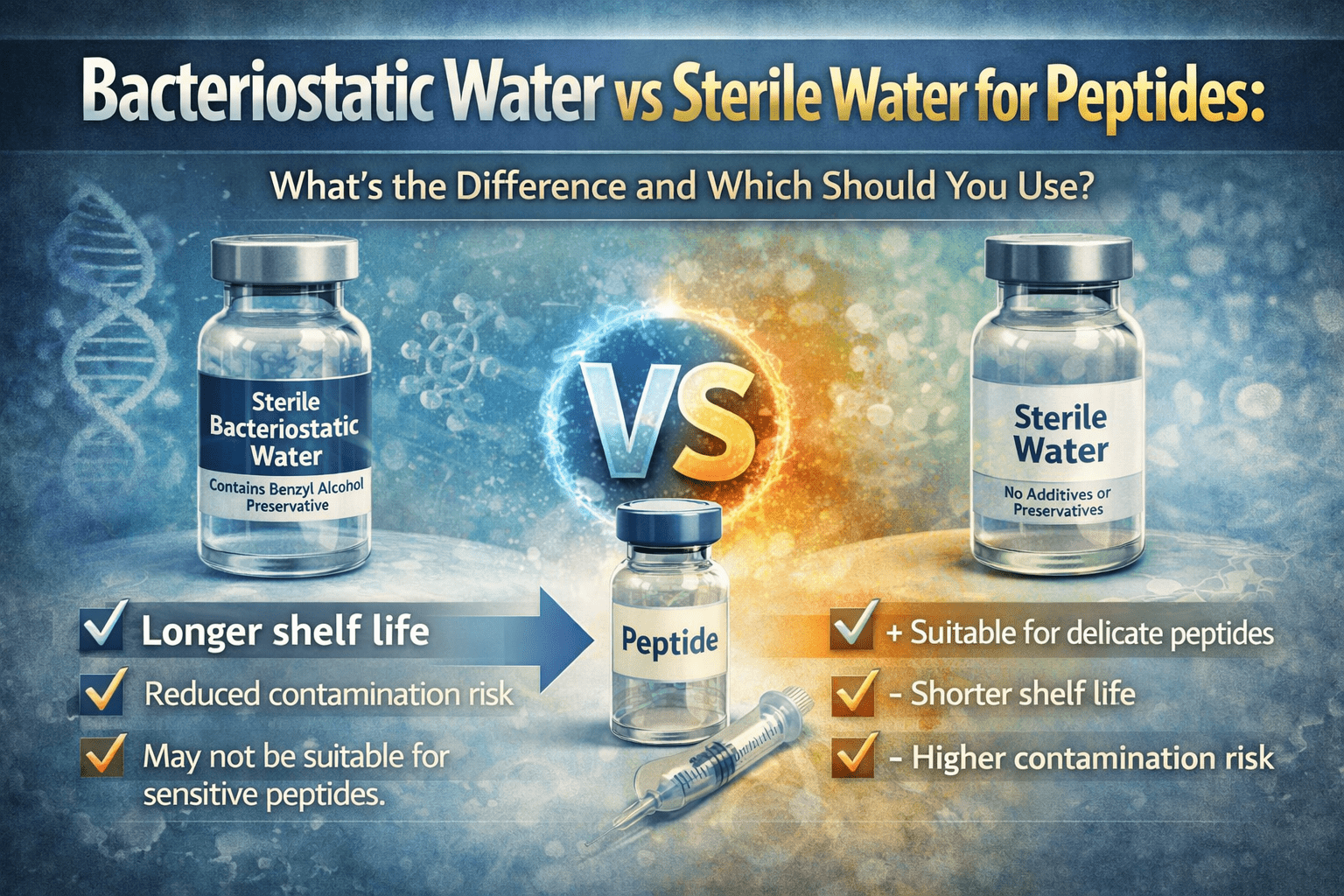 \n
\n \n\n
Common Mistakes and How to Avoid Them
\nEven when an individual secures an authentic supply, simple operational errors can compromise the entire protocol. Awareness of these common mistakes can prevent unnecessary site irritation or product degradation:
\n- \n
- Mistake 1: Exceeding the 28-Day Puncture Window. Many people assume that because a 30mL vial is half-full, it remains safe indefinitely. Mark the exact date of your first puncture directly on the label. Once day 29 arrives, discard the remaining solution regardless of how much is left. \n
- Mistake 2: Shaking the Vial Aggressively. When reconstituting delicate proteins or peptides, vigorously shaking the vial can break down the compound\'s structural integrity. Instead, gently swirl the vial between your palms until the powder completely dissolves into the clear solution. \n
- Mistake 3: Swapping Alcohol Swab Protocols. Never assume the rubber stopper stays clean just because the plastic cap was recently removed. Wipe the top of the rubber stopper with a fresh 70% isopropyl alcohol swab before every single entry. Allow it to air-dry completely for 10-15 seconds before inserting your needle. \n
- Mistake 4: Incorrect Temperature Storage. Freezing a preserved solution can cause the water and benzyl alcohol to separate, destroying its bacteriostatic efficacy. Store your vials at a controlled room temperature between 20°C and 25°C (68°F to 77°F) in a dark cupboard away from moisture. \n
\n\n
FAQ
\n\nIs it proven that bacteriostatic water prevents infection during multi-dose usage?
\nYes, clinical data confirms that the addition of 0.9% benzyl alcohol successfully inhibits the replication of vegetative bacteria over a standard 28-day timeframe. However, this is only true if proper aseptic techniques are practiced during every draw. The preservative cannot completely neutralize an overwhelming contaminant load introduced by dirty hands or non-sterile needles.
\n\nHow long does it take for a reconstituted solution to degrade?
\nThe degradation timeline depends entirely on the specific therapeutic compound being mixed, not the water itself. While the bacteriostatic water remains free of bacterial growth for 28 days after puncture, delicate medications dissolved within it may lose their potency much sooner—often within 7 to 14 days when refrigerated. Always cross-reference your specific drug\'s stability guidelines.
\n\nWhat are the side effects of bacteriostatic water injections?
\nThe most common side effect is a temporary localized burning, stinging, or mild redness at the injection site, typically caused by the mild acidity of the benzyl alcohol preservative. This usually subsides within a few minutes. Rare but serious side effects include localized tissue swelling, warmth, or systemic fever, which are indicators of contamination or severe hypersensitivity and require immediate medical evaluation.
\n\nCan it combine with all types of freeze-dried medications safely?
\nNo, it cannot be combined universally. Certain highly sensitive biological molecules or proteins will precipitate or unfold (denature) when exposed to the acidic nature of benzyl alcohol. Always verify with your prescribing physician or pharmacist whether your specific compound requires a preserved agent or if it must be mixed with non-preserved, plain sterile saline.
\n\nAre oral vs injection/alternative formats interchangeable for this product?
\nAbsolutely not. Bacteriostatic water is engineered specifically for parenteral injection or dilution. It should never be used as an oral solution, nasal spray baseline, or inhalation fluid unless explicitly directed by a specialized medical protocol. Using a preserved injection fluid for large-scale internal irrigation or inhalation can lead to mucosal irritation or localized chemical toxicity.
\n\n\n\n
A Practical 2-Week Experiment Framework
\nIf your medical professional has cleared you to begin a self-administered protocol using a preserved diluent, executing a brief baseline trial period can help you gauge your physical tolerance to the benzyl alcohol preservative. This structured approach helps isolate any localized site reactions before you introduce your actual active medications.
\n\nNote: This framework assumes you are using an authentic, physician-approved, unmedicated preserved water supply simply to practice aseptic technique and check for skin sensitivities.
\n\n- \n
- Days 1–3 (Preparation & Setup): Establish a clean, well-lit workspace free of drafts or household pets. Practice organizing your supplies: alcohol wipes, sterile single-use syringes, your 30mL multi-dose vial, and a dedicated sharps container. Restrict your movement to slow, deliberate actions to ensure a steady hand. \n
- Days 4–7 (Tolerance Tracking): Execute a small test draw according to your physician’s exact volume instructions. Administer the sterile diluent according to your protocol guidelines. Document any immediate physical feedback: Note if the common "stinging" sensation lasts longer than 60 seconds, or if any localized redness appears. Most minor site irritations clear up within 5 minutes. \n
- Days 8–14 (Sanitation Routine Mastery): Focus on developing perfect muscle memory. Ensure you never touch the needle tip to any surface, and verify that you are logging the exact day-count on your vial. If at any point during these two weeks you observe a lingering red welt, persistent itching, or a rash at the injection site, pause the framework and contact your doctor to discuss switching to a non-preserved alternative.\n
\n\n
About the Author
\nReviewer: Thomas Vance, Senior Medical Logistics Consultant & Clinical Equipment Analyst
\nExperience: 18 years specializing in healthcare supply chain integrity, sterile compounding accessories, and outpatient self-administration safety frameworks. Thomas has spent nearly two decades evaluating laboratory-grade hardware and clinical diluents for independent consumer consumer-advocacy publications.
Disclaimer: This article is intended solely for informational, educational, and search-optimization evaluation purposes. It does not constitute formal medical advice, diagnosis, or treatment. The author does not endorse, promote, or sell any specific product or web-based vendor. Always consult with a licensed, qualified physician or certified pharmacist before purchasing any medical supplies or altering your personal health and wellness routines.
\n\n
Discussion