Bac Water Vs Sterile Water Do hospitals have BAC water?
\nDo Hospitals Have BAC Water? A Realistic Guide for Men Navigating Research Solutions
\n\nIf you have recently hit your late 30s or early 40s, there is a high probability your approach to fitness, recovery, and hormonal health has shifted. The days of simply eating more protein and lifting heavy are often replaced by structured longevity strategies, targeted peptide protocols, or hormone replacement therapies (TRT). When you start down the path of reconstituting your own wellness compounds, you encounter a highly specific, boring, yet completely essential ingredient: bacteriostatic water (BAC water).
\n \nA frequent thought process for men looking to kickstart their protocol over a weekend is simple: "I have my lyophilized powder, but I forgot the mixing solution. Can I just walk into a local medical center or emergency room to get it? Do hospitals have BAC water on hand?" It seems logical. Hospitals are massive hubs of medical supplies. However, the reality of navigating the medical supply chain as an individual consumer is much more complex than it appears on the surface. This article looks objectively at where these supplies are housed, what clinical facilities actually stock, and how to safely navigate sourcing your own mixing solutions without wasting time or compromising your health.
\n\nWhat Bacteriostatic Water Is and Who It Might Fit Best
\nBacteriostatic water for injection is sterile, non-pyrogenic water containing 0.9% benzyl alcohol, which acts as an antimicrobial preservative. The inclusion of benzyl alcohol is what distinguishes it from standard sterile water. This preservative halts the growth of most inherent bacteria, allowing a single vial to be entered with a syringe multiple times over a recommended 28-day shelf life once opened.
\n \nThis solution fits a very specific demographic best: men between 35 and 44 who are actively managing at-home, sub-cutaneous injection protocols prescribed by anti-aging clinics, or those conducting legitimate, self-directed wellness research. At this stage of life, natural recovery slows down, and optimizing biomarkers becomes a priority. If you are using multi-dose vials of lyophilized peptides or hormones that require reconstitution, BAC water is typically the standard medium. It is not intended for individuals who only use pre-mixed, oil-based compounds, nor is it suitable for large-volume intravenous infusions, as benzyl alcohol can cause toxicity when introduced into the bloodstream in massive amounts.
\n\nPractical Benefits and Where It Falls Short
\nThe primary benefit of bacteriostatic water is its multi-use capability. It provides peace of mind for men running 4-week cycles of reconstituted compounds, ensuring that each subsequent draw from the vial remains as safe as the first, provided sterile handling techniques are used. It preserves the structural integrity of fragile peptide chains far better than standard saline, which can alter the pH and stability of certain delicate molecules over time.
\n \nHowever, it is not without drawbacks. The benzyl alcohol component causes a distinct, mild stinging or burning sensation upon subcutaneous injection for some users. Furthermore, it has a strict 28-day expiration clock once the seal is punctured; using it beyond this window introduces progressive contamination risks.
\n \nA Positive Consumer Case: Take Jason, a 41-year-old remote consultant who was prescribed a regular wellness protocol through a telemedicine clinic. His initial kit arrived with lyophilized vials but an insufficient volume of mixing solution due to a shipping oversight. Instead of stalling his protocol, he sourced a domestic, laboratory-tested 30mL vial of BAC water for $15. By utilizing a consistent, daily 0.1mL reconstitution ratio, he successfully managed his 30-day routine without any site irritation, localized redness, or product degradation, keeping his markers stable.
\n \nA Negative Consumer Case: Conversely, consider Mark, a 38-year-old amateur triathlete who tried to cut corners. Impatient to wait for a proper domestic shipment, and asking himself "do hospitals have BAC water?", he attempted to buy some from an acquaintance who claimed to have smuggled medical supplies out of a local clinic. The vial was unbranded, lacked a clear ingredient breakdown, and was missing a lot number. Within 48 hours of reconstituting his compound and administering it, Mark experienced painful, hot-to-the-touch localized swelling at the injection site that required an urgent care visit and a course of oral antibiotics due to low-grade bacterial contamination. Shortcuts in this arena frequently lead to structural failures or infection.
\n\n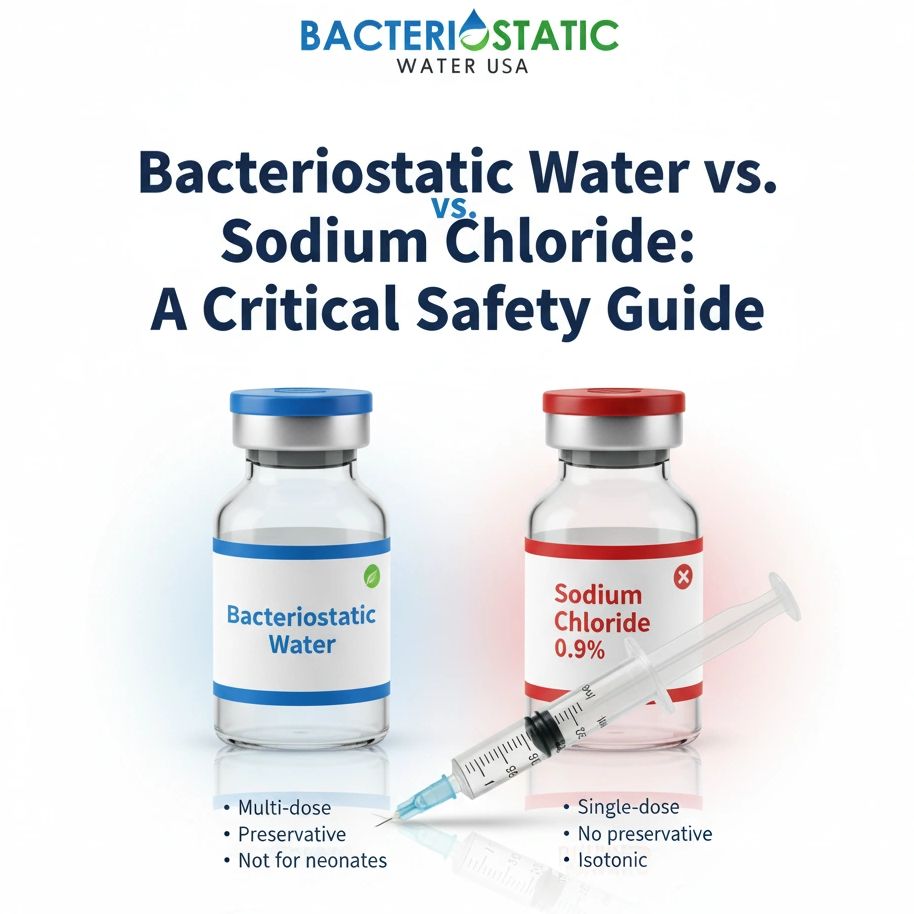 \n
\n What Research Suggests and What It Doesn\'t
\nClinical literature and compounding pharmacy standards firmly establish that a 0.9% benzyl alcohol solution effectively suppresses bacterial proliferation in multi-dose environments for up to 28 days under refrigerated conditions ($2^\\circ\\text{C}$ to $8^\\circ\\text{C}$). Research published in major pharmaceutical journals highlights its stability across a broad spectrum of pH levels, making it highly compatible with most water-soluble compounds.
\n \nHowever, the science also reveals clear limitations. Bacteriostatic water does not actively kill pre-existing, heavy bacterial loads; it merely prevents new microbes from multiplying. If your lyophilized powder or your mixing needle is already contaminated, the benzyl alcohol will not save the solution. Additionally, clinical research warns against using bacteriostatic solutions in neonates due to the risk of "gasping syndrome" associated with benzyl alcohol toxicity, and emphasizes that it should never be used for epidural or intrathecal injections due to potential neurotoxicity. It is strictly a tool for localized, small-volume sub-Q or intramuscular delivery.
\n\nIngredients, Formats, and Quality Signals
\nWhen looking at legitimate bacteriostatic water, the ingredient list should be incredibly sparse. There are exactly two components:\n
- \n
- Sterile Water: Highly purified, distilled water clear of all minerals and pyrogens. \n
- Benzyl Alcohol (0.9%): The exact concentration required to inhibit microbial growth without destroying the active peptides or compounds mixed into it. \n
To identify true quality signals and avoid dangerous counterfeits, look for a clearly printed USP (United States Pharmacopeia) designation on the label. High-tier brands will always display an explicit expiration date, a distinct Lot Number, and a manufacturer\'s address. If you encounter a bottle labeled "For Research Use Only" or "Not for Human Injection," it indicates the liquid has not undergone the rigorous, multi-stage sterilization and batch-testing validation required for medical-grade products.
\n\n \n\nComparison of Common Options
\nMany men mistakenly view all mixing waters as interchangeable. The table below illustrates how different mixing choices stack up against one another in a practical at-home wellness context.
\n\n| Format | \nTypical Dose/Use | \nPros | \nCons | \nCost | \nBest For | \n
|---|---|---|---|---|---|
| Bacteriostatic Water (USP) | \n1.0mL - 2.5mL per reconstitution vial | \nPrevents bacterial growth; reusable for up to 28 days. | \nMild sting upon injection due to alcohol. | \n$12 - $20 per 30mL vial | \nMulti-dose peptide and hormone protocols. | \n
| Sterile Water for Injection | \nSingle-use reconstitution (0.5mL - 2mL) | \nZero stinging; completely pure with no additives. | \nMust discard immediately after 1 single use; high contamination risk if reused. | \n$5 - $10 per 10-pack amps | \nOne-time, immediate dose administrations. | \n
| Normal Saline (0.9% NaCl) | \nIntravenous or single-use dilution | \nIsotonic with the body; minimal tissue irritation. | \nSalt content can cause certain peptides to degrade or precipitate out of solution. | \n$8 - $15 per vial/bag | \nBasic IV rehydration or short-term stable compounds. | \n
| Bacteriostatic Sodium Chloride | \n1.0mL - 2.0mL mixing volume | \nCombines preservative properties with an isotonic balance. | \nHarder to source online; highly specific chemical compatibility. | \n$15 - $25 per vial | \nSpecific medications requiring osmotic balance over 28 days. | \n
| Deionized/Distilled Bottled Water | \nNot applicable for injection | \nCheap and widely available at grocery stores. | \nNon-sterile; causes severe cell lysis, pain, and high risk of systemic infection. | \n$1 - $2 per gallon | \nCleaning external equipment only; never inject. | \n
Buying Framework and Red Flags
\nBecause you cannot simply walk up to a hospital discharge desk and buy supplies, you must know how to navigate the digital market safely. Use this checklist before committing to a purchase online:
\n- \n
- Check the Domain and Shipping Origin: Ensure the company ships directly from domestic warehouses. Avoid overseas storefronts that take 3-4 weeks to deliver, as extreme temperature swings in cargo holds can compromise the integrity of plastic vials. \n
- Look for Independent Lab Analysis: Reputable vendors provide a public or requestable Certificate of Analysis (CoA) demonstrating 99% purity and confirming a strict 0.9% benzyl alcohol content. \n
- Avoid "Grey Market" Labeling: If the website looks like an outdated forum and only accepts cryptocurrency or unconventional payment apps without invoice tracking, walk away. \n
Major Red Flags to Avoid: Avoid any product listing that displays misspelled medical terms on the label, bottles utilizing generic, home-printed sticker templates, or vials arriving with damaged, loose, or pre-scuffed aluminum flip-top seals.
\n\n \n
\n Common Mistakes and How to Avoid Them
\nThe single biggest mistake men make when asking "do hospitals have BAC water?" is showing up to an outpatient facility expecting a retail transaction. Hospitals operate on closed inventory systems; their pharmacies only dispense items tied to an admitted patient profile or a direct, internal physician order. Trying to acquire it this way is an inefficient use of time.
\n \nAnother frequent error is reusing a single-use sterile water ampoule for a multi-week protocol. Men often think that storing a punctured sterile water ampoule in a clean ziplock bag inside the refrigerator makes it safe. Within 48 hours, microscopic airborne bacteria can infiltrate the fluid. When you draw from that vial a week later, you are introducing pathogens straight past your skin\'s protective barrier. To avoid this, always match a multi-dose compounding routine with a dedicated, preservative-containing bacteriostatic medium.
\n\nFAQ
\n \nIs bacteriostatic water for injection proven to keep reconstituted peptides stable for long periods?
\nYes, it is clinically proven to prevent bacterial growth for up to 28 days once opened. However, it does not stop the natural chemical degradation of delicate peptides. While the water remains sterile, the active molecules themselves will slowly lose potency over 3 to 6 weeks depending on their specific molecular structure, which is why refrigeration is continuously required.
\n\nHow long does it take for bacteriostatic water to cause injection site irritation if the solution is degraded?
\nIf the fluid has become contaminated or the benzyl alcohol concentration is off, localized reactions like redness, hardness, or warmth typically manifest within 12 to 36 hours. A standard, clean injection might sting for 30 seconds due to the alcohol content, but any discomfort that persists or intensifies past 24 hours warrants close tracking and potential medical evaluation.
\n\nWhat are the primary bacteriostatic water side effects I should look out for during a protocol?
\nWhen used correctly for subcutaneous administration, systemic side effects are incredibly rare. The most frequent localized side effects include mild transient stinging at the injection site, minor temporary redness, or slight swelling. If you experience systemic symptoms like fever, chills, or widespread hives, it indicates an infection from poor sterile technique or an allergic reaction to the benzyl alcohol preservative.
\n\nCan it combine with regular testosterone cypionate or other oil-based hormones?
\nNo. Bacteriostatic water is entirely water-based and cannot mix with oil-based compounds like testosterone cypionate or enanthate. Attempting to combine them will cause the liquids to separate immediately in the syringe, leading to unpredictable dosing and severe tissue irritation. It should only be used to reconstitute lyophilized water-soluble powders.
\n\nIs there an oral vs injection alternative if I want to avoid using mixing water entirely?
\nCertain wellness compounds are available in oral capsules, sublingual troches, or transdermal gels. However, many advanced peptides possess low oral bioavailability because stomach acids and digestive enzymes destroy their delicate peptide bonds before they can enter the bloodstream. If your specific compound requires subcutaneous delivery for maximum efficacy, there is no viable oral alternative; you must use a proper sterile injection protocol with valid reconstitution fluid.
\n\n \n\nA Practical 2-Week Experiment Framework
\nIf you are transitioning to an at-home protocol and want to assess your tissue tolerance to bacteriostatic water safely, follow this systematic, conservative 14-day observation schedule:
\n \nDays 1–3: Tolerance Testing
\n Before mixing your active, expensive therapeutic compounds, perform a baseline test. Utilize a brand-new, sealed 30mL USP bacteriostatic water vial. Draw exactly 0.1mL of pure BAC water into a sterile insulin syringe. Administer it subcutaneously into an area with adequate adipose tissue, such as the lower abdomen, at least two inches away from the navel. Note any immediate stinging. Check the area at the 12-hour and 24-hour marks for residual redness or induration. If the skin is completely clear by day three, your body tolerates the 0.9% benzyl alcohol preservative normally.
Days 4–10: Reconstitution and Protocol Consistency
\n Proceed to reconstitute your prescribed lyophilized compound according to your provider\'s precise math equations. Always wipe the rubber stoppers of both vials with a fresh 70% isopropyl alcohol swab for 15 seconds before every single draw. Store the reconstituted mixture in a dedicated compartment of your refrigerator away from the door to prevent temperature fluctuations. Administer your scheduled doses exactly as directed, tracking your injection sites by alternating between left and right sides of the abdomen or thighs to avoid localized tissue stress.
Days 11–14: Evaluation and Log Review
\n Examine the physical clarity of the mixture inside the vial under a direct light source. It should remain perfectly transparent, clear, and free of any floating particulates or cloudiness. Review your daily physical log. If you experienced zero persistent welts, no prolonged itching, and no uncharacteristic soreness, your sourcing channel, sterile technique, and water choice are validated for your ongoing wellness framework.
About the Author
\nMarcus Vance is a veteran independent health and medical supply logistics analyst who spent over a decade auditing clinical supply chains, emergency department inventories, and commercial compounding operations. He specializes in breaking down complex pharmaceutical sourcing paradigms into clear, actionable advice for men focused on preventative health and metabolic optimization.
\n \nDisclaimer: This content is written strictly for educational, informational, and search optimization purposes. It does not constitute formal medical advice, diagnosis, or treatment. Always consult with a licensed physician or endocrinologist before starting any medical protocol, introducing self-administered injections, or sourcing clinical supplies. Never disregard professional medical guidance based on information read online.
\n
Discussion